
What's It About?
In which I try to work out what books are about with examples from current reading and of course get sidetracked

When you ask people who work in film what a particular film is about they will confidently go at some length into plot description: And then he finds out that she, the younger one, was in one of the pornos, and there’s drugs and he finds out about the blackmailing ring, but before that there’s this great scene in a bookshop, and meanwhile there’s this club owner who might or might not be behind everything… I find it difficult though to believe, even in films, that the meaning of the thing is in the events that take place or the order of the events that take place. I watched The Big Sleep the other night. Is that about the troubled daughters of a rich invalid? About a detective investigating a pornography and blackmail ring? Isn’t it more ‘about’ Humphrey Bogart and Lauren Bacall and the effect they have on each other in rooms at night and therefore the effect that that has on the audience?
With books it’s an even harder question to answer. In the lead-up to publication I’m trying to work out how to explain what it is that I’ve written, or at least how to frame what I’ve written for its best reading experience, but I have trouble answering the question even when it’s about a book I’m reading.
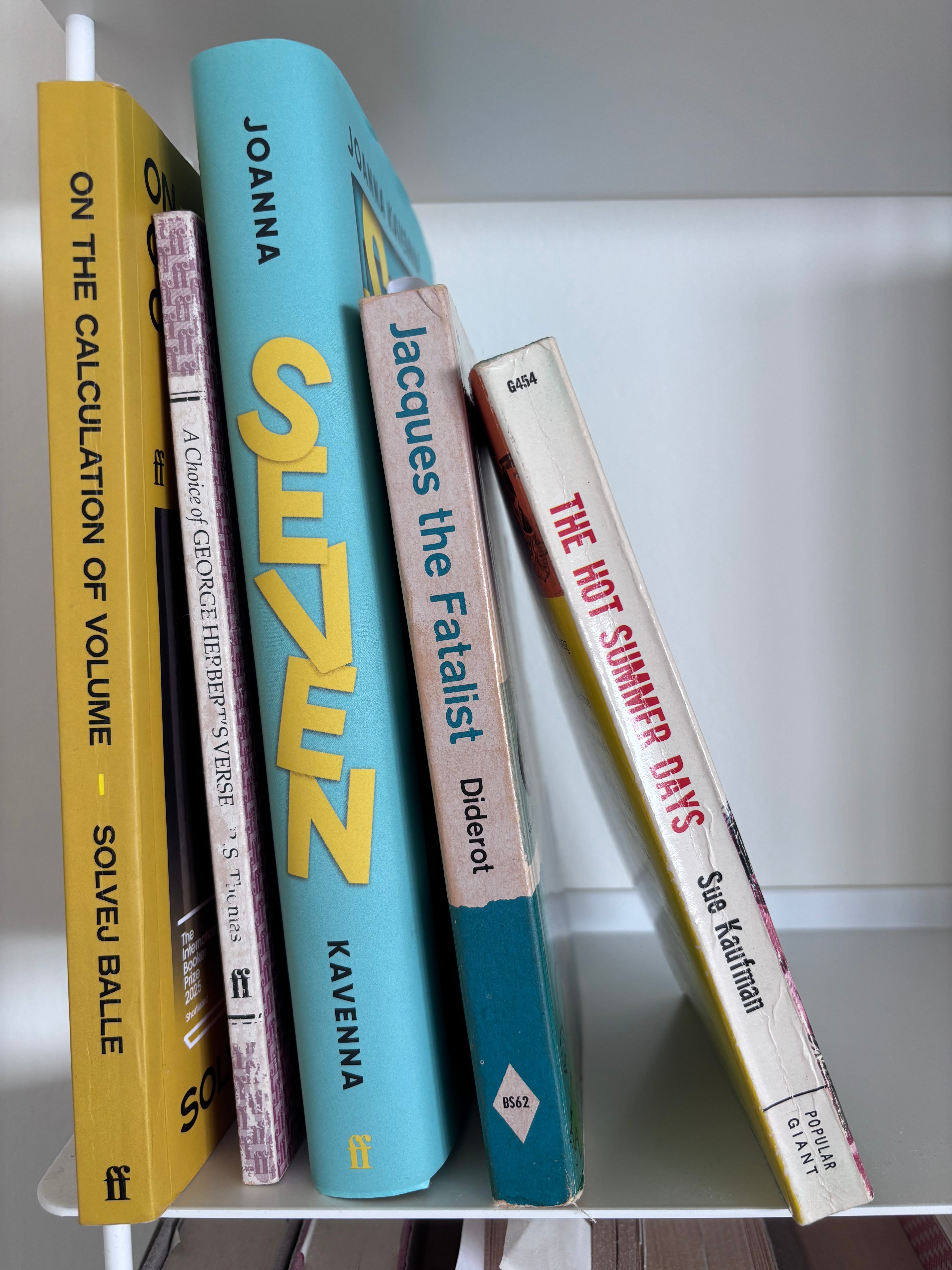
The picture above was taken a few days ago of the books that I have currently on the go.
I read them at different times of day, in different settings. They were all acquired in different ways, for different reasons; they were written in different countries, in different centuries, in different forms, so it is hard to imagine that they are ‘about’ the same things.
Joanna Kavenna’s new novel, Seven, is a joy for anyone interested in games and the philosophies of games. Its unnamed and gender-unspecific narrator goes on a very funny ludic odyssey. Kavenna sets them adrift, at sea (sometimes literally), at the mercy of tyrannical philosophers and the game, Seven, whose rules no one can quite agree on, in a novel that mocks most intellectual structures, including its own. But that’s a summary. Dangerously close to a retelling of the plot.
Even more extremely stuck inside a structure they can’t properly navigate or explain or account for is Balle’s bookseller who gets stuck in time, and who has to keep reliving the 18th of November. There are seven volumes of this and On the Calculation of Volume is sort of like Groundhog Day, without the grooming, with more mature emotions, and in a more sombre register.
So is that how to do it? Find comparisons? My book is like…?
I bought the book of George Herbert’s poetry along with the Diderot anti-novel at a second-hand book stall. I’ve been meaning to read Herbert for years, catching a sense that there’s something very special about his work, but his reputation as the closest the Anglicans have to a saint has kept me away until now.
There’s a dedication inside the cover:
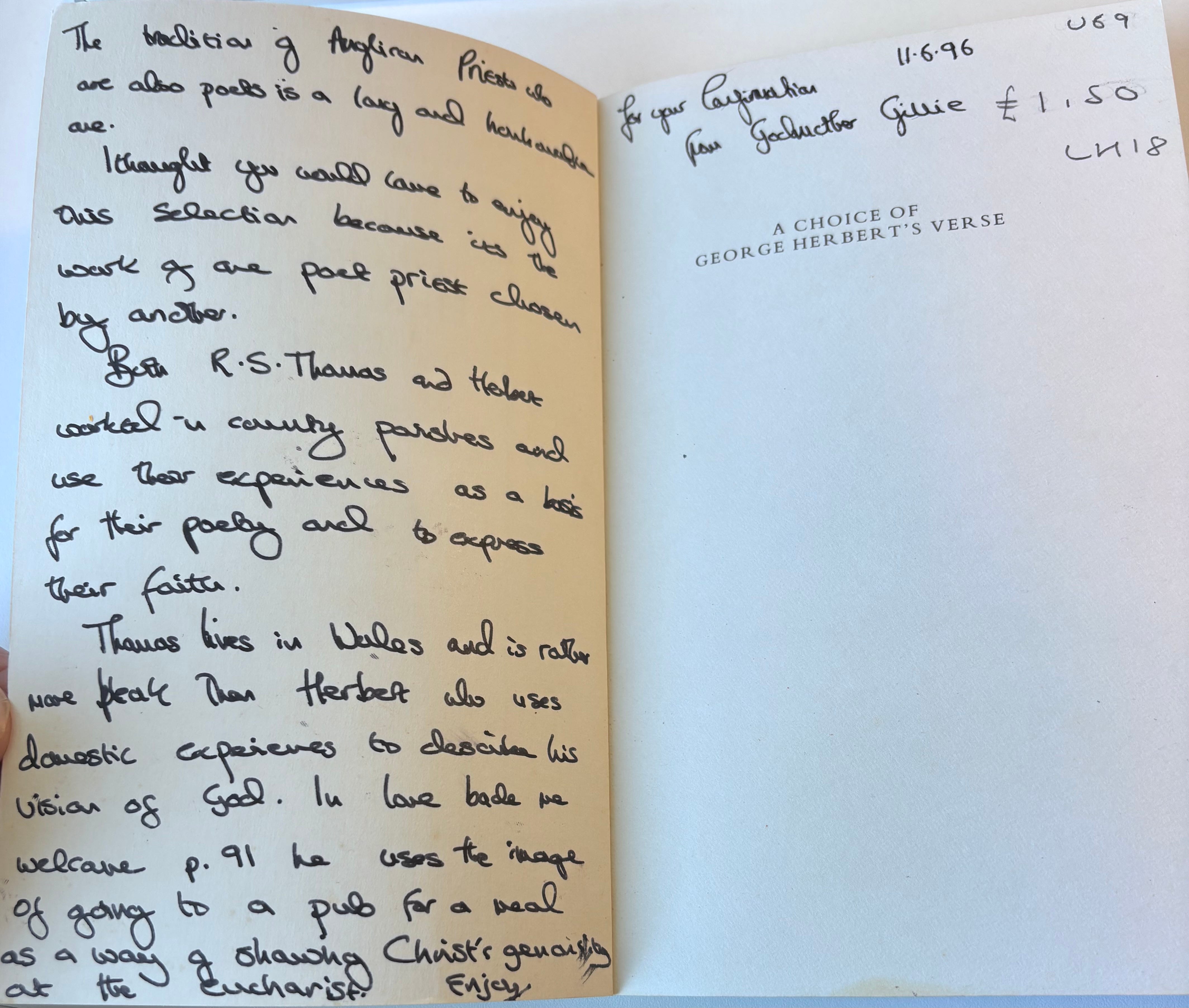
The tradition of Anglican Priests who are also poets is a long and honourable one.
I thought you would come to enjoy this selection because it is the work of one poet priest chosen by another.
Both R.S. Thomas and Herbert worked in country parishes and use their experiences as a basis for their poetry and to express their faith.
Thomas lives in Wales and is rather more bleak than Herbert who uses domestic experiences to describe his vision of God. In love bade me welcome p.91 he uses the image of going to a pub for a meal as a way of showing Christ’s generosity at the eucharist.
Enjoy.
11.6.96
for your confirmation
From Godfather (?) Gillie
I don’t think that the unnamed recipient of Godfather Gillie’s gift turned to p.91 to study how a visit to the pub could show Christ’s generosity at the eucharist. The spine of the book is scarred as if it has been picked at or battered but it is still tight, as new, and had previously been either unopened apart from the writing of the dedication, or read so carefully that none of its pages show any sign of use. I’m guessing the first is true. And I’m guessing that if he did read it, the line ‘You must sit down, says Love, and taste my meat’ would have elicited guffaws rather than thoughts of salvation.
But it’s so poignant. Godfather Gillie might be a priest himself. Maybe he even wrote some poetry, which I’m imagining as carefully shaped, showing his receptiveness to nature and beauty and other examples of what he would celebrate as God’s handiwork, or maybe even ‘Handiwork’. Here, he’s doing his best as a godfather (at least I think that’s ‘Godfather’ in his signature) to find something to appeal to his young friend, or charge, or confirmee. The ‘I thought you would come to enjoy this selection because it is the work of one poet priest chosen by another’ is sweetly, forlornly hopeful, an expression of his interests that he wants to reveal while knowing that it won’t be shared. Also forlorn is his attempt to cast the setting of the poem on p.91 as the visit to a ‘pub’. I’m taking it as a rough try at being thought relevant. And making a poem written around 1630 appear contemporary to a late-twentieth century reader who had no interest in it. All of this is poignant, and quite painful: the acknowledgment that the fruits of this gift can only arrive in some unknown conditional future (‘would come to enjoy’) rather than be open to pleasure quite yet, the dogged attempt to make a connection, to give something suitably exalted on the occasion of the boy’s confirmation.
Like Balle’s narrator I feel I’ve stumbled into someone else’s time. I’m completely not the reader that Gillie intended. I’m much older than the recipient and probably older than the giver. I have no religious faith. But I’m liking the poems more than I expected to. What are they about? They read like a beautifully wrought bridge to a world of faith and hope and submission that was designed with the help of Emily Dickinson. Which is entirely ahistorical and personal, telling you something of my experience and tastes without regard for Herbert’s intentions.
I put it to one side, because I was going to Vienna for a few days, for which I thought that Diderot’s book would be a livelier travelling companion.
I spent most of the time on the bus to Stansted and the Ryanair flight reading Jacques the Fatalist and His Master. It’s as clever and ambitious as you might expect from the great encylopedist, clearly in debt to Sterne’s Tristram Shandy, with longueurs, interruptions, questions about its own standing, and enough philosophy and jokes to make Kavenna happy and R.S. Thomas annoyed. Its central questions are about fate and freedom and free will and when I got through passport control at Vienna airport I realised four things: that all the reading matter on this shelf, apart from the Sue Kaufman book, which I’ll write about another time, are first-person narratives; that they might actually be ‘about’ those same questions of fate and free will and design and chance; thirdly, that maybe all literature is about those things, in which case why bother asking the question at all; but as I was puzzling over that, and deciding that they had to be each about something else as well, rather as The Big Sleep is less about its plot and more about the experience of Bogart and Bacall in a room, and why bother reading unless we are open to being changed, the fourth thing I realised was that I’d inadvertently left Jacques the Fatalist behind in the seat pocket of the plane, and I supposed I had to take that loss as if it was meant to be.